
Should You Trust AI for Your Key Financial Decisions?

Everyone seems to be using AI for everything now.
Travel plans. Legal questions. Medical symptoms, you name it. I say this as an avid user of multiple AI agents myself.
And increasingly,more and more people are using it to help with their money. Which got me thinking: can you actually trust AI with your financial decisions?
This sent me down a bit of a rabbit hole. And what I found was more nuanced than I expected. AI can genuinely help automate a lot. But it also struggles in specific areas, and those areas can be extremely costly if they go unnoticed.
Putting It to the Test
There's only one way to find out if AI can be a trustworthy source for financial decision-making: A head-to-head.
I took a relatively simple retirement scenario: a married couple approaching retirement, own a home, have RRSPs and TFSAs. Then I ran it through two sources: our industry-grade financial planning software, and ChatGPT.
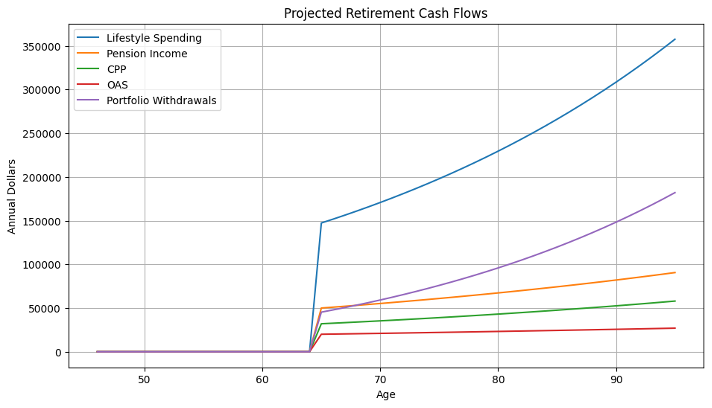
The surface results? Actually impressive. Both produced similar recommendations, assumed comparable growth scenarios, and even landed on similar early retirement dates. The retirement cash flow graph was a little confusing (see below), but still impressive nonetheless.
If you stopped there, you might think ChatGPT is all you need. But then when I dug a little deeper, some things got muddy.
Where It Starts to Break Down
The issue with AI isn't that it gives you obviously wrong answers. It gives you answers that feel right, polished, confident, detailed. And that's exactly what can make them dangerous.
Here's what I kept running into:
It only knows what you tell it
AI builds on the inputs you provide. If you don't know to mention that your TFSA contribution room has been partially used, or that a leave of absence affected your CPP calculation, the AI probably won't ask. It just builds a plan on whatever foundation you gave it.
The tax math in my head-to-head was wildly different
Like I said, the surface numbers looked similar, but the underlying tax calculations were off. Most AI tools work from data up to a specific point in time. So recent changes to the tax code may not be captured. And in Canada, provincial rules, credits, and thresholds vary significantly. Simply not mentioning which province you're in can wildly skew the results. I even ran across a scenario where the calculation was factoring in a 66% capital gains inclusion rate (note that this started as an idea and was abolished a couple years ago).
Here's another example that stuck with me
I tested ChatGPT on a complex multi-transaction TFSA contribution room calculation. I already knew the answer, which was: zero room available for the current year. ChatGPT told me I could safely contribute around $16,000.
If someone acted on that advice, they'd be hit with a 1% monthly penalty on the overcontribution. Yikes.
It forgets everything
AI platforms have memory problems. If you go in and start a new chat, and it has no idea what you discussed before. If you are building a retirement plan, you know that it will need constant adjustments as life changes. If not used properly, AI may reset your plan on you, forcing you to build again from scratch.
And the unpaid versions are even less reliable
Worth mentioning: free versions of AI platforms have been shown to provide less reliable information than paid ones. Chat GPT will actually warn you that the free version tier is less reliable when you are in the process of cancelling a paid subscription. If you're making major financial decisions based on the free tier, be aware you may be prone to a wider range of outcomes.
What AI Actually Does Well
This piece is not meant to bash AI agents. In the right hands, AI is genuinely impressive. A sharp, well-informed person using AI as a thinking partner can get tremendous value from it.
It can explain complex concepts in plain language, summarize lengthy documents in seconds, and can be an exceptional brainstorming partner.
Our team uses it every day to turn dense topics into tools that are clear and useful.
So Should You Trust It?

Yes and no.
Use AI to learn, explore, and ask the questions you'd feel awkward Googling or asking out loud. It's exceptional in that role.
But for the decisions that actually shape your retirement like when to draw CPP, how to sequence your accounts, how to deal with the family dynamics of passing down your wealth - that requires someone who knows you, stays current on the rules, and has real accountability for getting it right.
So the risk isn't that AI gives you a wrong answer. It's that it gives you one that feels complete and you act on it before anyone catches what's missing. And that mistake could be one that is much harder to undo.
This publication is for informational purposes only and shall not be construed to constitute any form of advice. The views expressed are those of the author alone. Opinions expressed are as of the date of this publication and are subject to change without notice and information has been compiled from sources believed to be reliable. This publication has been prepared for general circulation and without regard to the individual financial circumstances and objectives of persons who receive it. You should not act or rely on the information without seeking the advice of the appropriate professional.
- Hits: 1711