
INWP Lender Spotlight: August 2026
Northern Ontario Housing & Mortgage Monthly
For clients in North Bay, Greater Sudbury, Muskoka, Sault Ste. Marie & Timmins — August 2026

Executive Summary - August 2026
Market Snapshot:
- Northern Ontario housing activity strengthened heading into the summer, although conditions vary considerably by community.
- Greater Sudbury recorded a meaningful increase in sales, while North Bay activity remained close to historical norms.
- New listings and active inventory continue to increase, giving buyers more choice without causing a broad decline in property values.
- The Bank of Canada maintained its overnight policy rate at 2.25% on July 15.
- Fixed mortgage rates remain under modest upward pressure from elevated Government of Canada bond yields.
- Rental demand and relative affordability continue supporting investor activity across Northern Ontario.
The regional market is no longer moving uniformly toward buyer-friendly conditions. Sudbury and Timmins remain comparatively tight, while Muskoka and portions of Sault Ste. Marie offer buyers considerably more negotiating room.
Interest Rates and Forward Outlook
The Bank of Canada maintained its overnight policy rate at 2.25% on July 15, with the Bank Rate remaining at 2.50% and the deposit rate at 2.20%.
The Bank indicated that the Canadian economy is beginning to improve following an extended period of weakness. Growth is picking up, while inflation is expected to gradually return toward the Bank’s 2% target. However, global energy prices, conflict in the Middle East and uncertainty surrounding United States trade policy remain material risks.
The next scheduled Bank of Canada interest-rate announcement is September 2, 2026.
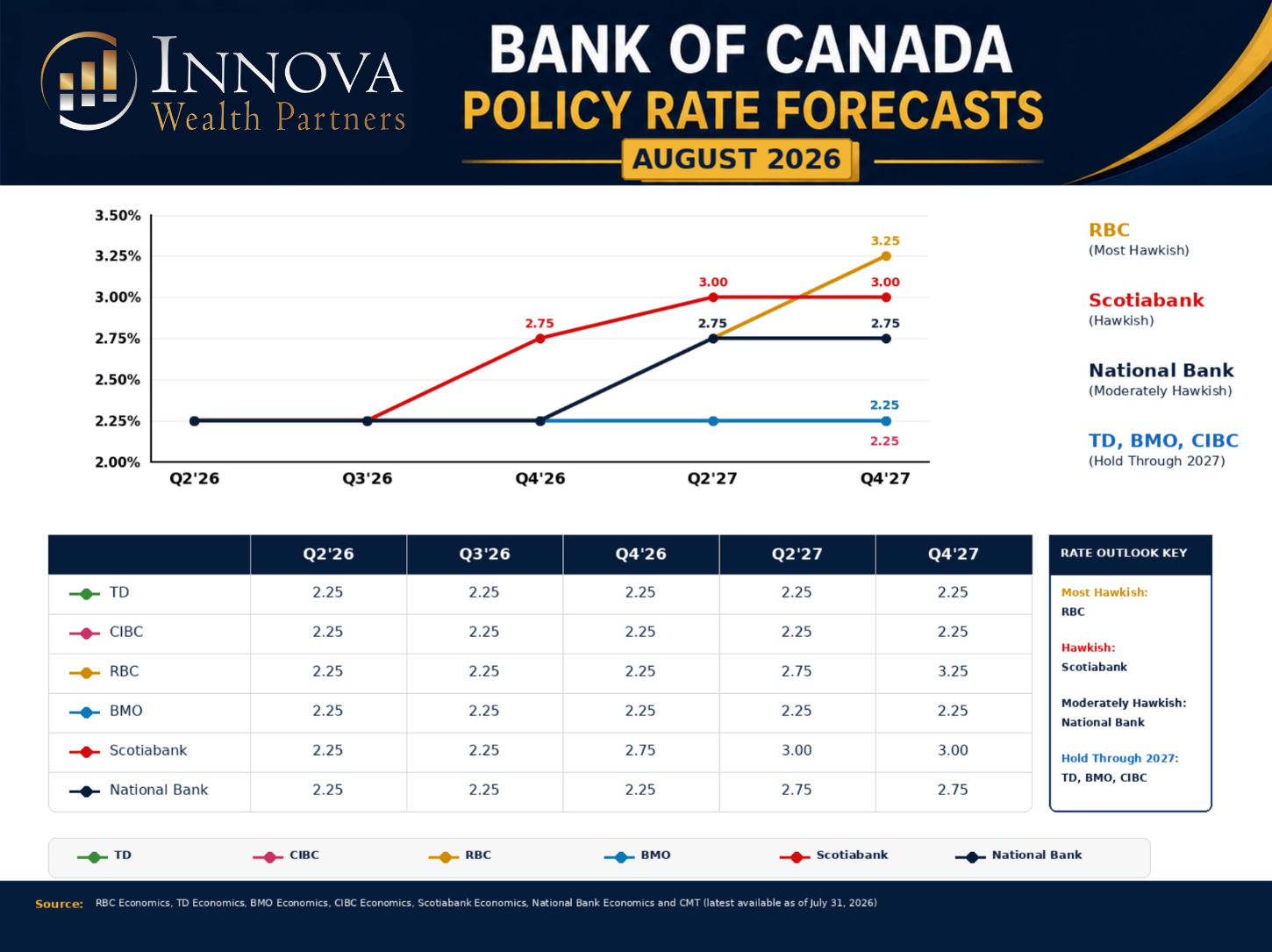
Most major Canadian bank economists expect the overnight rate to remain at 2.25% through the end of 2026. BMO, CIBC, National Bank, RBC and TD currently support the extended-hold outlook, although Scotiabank has maintained a more cautious view regarding the risk of future increases if inflation remains persistent.
Current Rate Environment
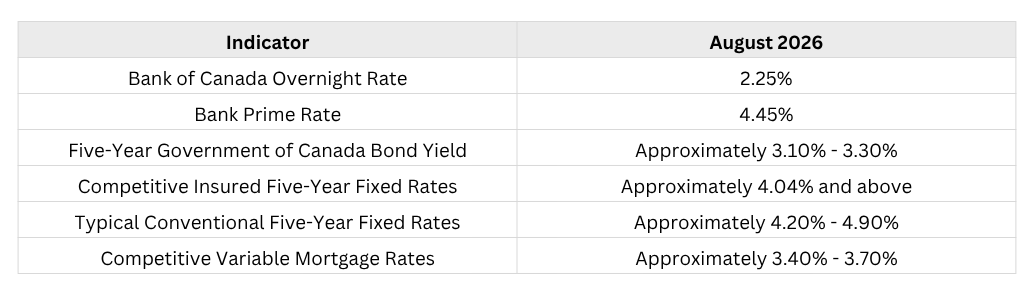
Canada’s major-bank prime rate remains 4.45%. Competitive insured five-year fixed rates began August at approximately 4.04%, while variable-rate products generally remain below comparable fixed-rate products.
Fixed mortgage pricing may continue fluctuating even if the Bank of Canada leaves its policy rate unchanged. Five-year fixed rates are primarily influenced by Government of Canada bond yields, which remain sensitive to inflation expectations, oil prices and international developments.
Bank of Canada Policy Rate Forecasts
Base Case
The Bank of Canada maintains the overnight rate at 2.25% through the remainder of 2026.
Supporting factors include:
- Improving but still moderate economic growth
- Inflation gradually moving toward target
- Excess capacity remaining within portions of the economy
- Elevated global and trade-policy uncertainty
- A desire to avoid unnecessarily restricting the housing and consumer sectors
Upside Rate Risk
A rate increase would become more likely if:
- Energy prices remain elevated
- Headline inflation becomes embedded in broader consumer prices
- Wage and service-sector inflation remain persistent
- Economic growth materially exceeds the Bank’s expectations
Downside Rate Risk
A further rate reduction would likely require:
- A significant economic slowdown
- Material labour-market deterioration
- A major negative trade shock
- Inflation falling sustainably below the Bank’s target
For mortgage borrowers, the most probable near-term outcome remains stability in variable rates combined with continued volatility in fixed rates.
National and Ontario Market Trends
Canadian home sales increased by a further 0.5% in June, following stronger gains in April and May. National sales activity was approximately 7% higher than its March level, suggesting that the spring market began later than usual but entered the summer with improving momentum.
Ontario recorded 18,051 residential sales in June, an increase of 5.5% from June 2025. Activity was slightly above the five-year average but remained 12.3% below the 10-year average.
Northern Ontario continues to benefit from:
- More attainable purchase prices than Southern Ontario
- Stable public-sector, mining, healthcare and education employment
- Strong demand for entry-level housing
- Limited purpose-built rental supply
- Relatively attractive rental yields
- Less exposure to speculative condominium development
Conditions are becoming increasingly localized. Buyers and sellers should avoid relying exclusively on provincial or national headlines when evaluating individual Northern Ontario markets.
North Bay Market Snapshot

North Bay recorded 143 residential sales in June 2026, a decline of 4.7% from June 2025.
Sales were approximately 1% above the five-year average but remained 7.2% below the 10-year average for the month. This suggests that the market is functioning close to recent norms despite softer year-over-year activity.
Current Conditions
- Sales activity remains relatively balanced.
- Entry-level and moderately priced homes continue attracting the strongest demand.
- Buyers have more time to complete financing and property due diligence than during the pandemic-era market.
- Properly priced homes in desirable neighbourhoods continue selling efficiently.
- Higher-priced and rural properties generally require longer marketing periods.
Market Position: Balanced
Note: North Bay continues to offer a relatively stable environment in which neither buyers nor sellers hold a decisive advantage across the entire market.
Sudbury Market Snapshot

Greater Sudbury produced one of the strongest June results among the major Northern Ontario markets.
A total of 339 homes sold in June, an increase of 15.7% from June 2025. The average sale price was approximately $509,204, representing a modest year-over-year decline of 0.9%.
New listings increased to 557, the highest June total in approximately a decade. Despite the increase in supply, months of inventory declined to approximately 2.3 months, reflecting continued competition for well-positioned properties.
Current Conditions
- Sales activity has strengthened materially.
- New listings are increasing.
- Active inventory remains below long-term norms.
- Detached-home pricing remains relatively stable.
- Properties requiring substantial renovations face greater buyer resistance.
- Turnkey homes in established neighbourhoods continue attracting strong interest.
Market Position: Moderate seller’s market
Mining, healthcare, education and public-sector employment continue to support underlying housing demand. Sudbury’s rental market also remains attractive to investors, particularly for legal secondary suites and small multi-residential properties.
Note: Buyers have more selection than in previous years, but desirable properties can still generate competitive offers.
Timmins Market Snapshot

Timmins and the surrounding Cochrane and Timiskaming districts continue to display tight market conditions.
Single-detached homes had approximately two months of inventory at the end of the second quarter, down from 2.4 months one year earlier. The median time required to sell a detached home declined to 18 days, compared with 25 days during the second quarter of 2025.
Available transaction data indicates that approximately 71 Timmins homes sold during June, with an average sale price near $390,000 and a median price of approximately $350,000. These figures should be treated as supplementary rather than official board statistics.
Current Conditions
- Inventory remains relatively tight.
- Properly priced detached homes are selling more quickly than last year.
- Rental demand remains strong.
- Entry-level homes and duplex-style properties remain attractive to investors.
- Older housing stock makes inspections and capital-expenditure planning especially important.
Market Position: Seller-leaning balanced market
Note: Timmins remains one of Northern Ontario’s more compelling investor markets, but acquisition decisions should be based on verified rents, realistic repair budgets and conservative vacancy assumptions.
Sault Ste. Marie Market Snapshot

Sault Ste. Marie recorded 181 home sales in June, an increase of 23.6% from May.
The average sale price was approximately $343,724, down 2.9% from June 2025. Active listings increased to 596, approximately 22.4% higher than one year earlier, while months of inventory reached approximately 3.3 months.
New listings increased by more than 23% year over year, providing buyers with substantially more choice.
Current Conditions
- Sales activity improved entering the summer.
- Inventory is materially higher than last year.
- Prices remain comparatively affordable.
- Buyers have increased negotiating leverage on listings that have remained on the market.
- Sellers face greater competition from comparable properties.
Market Position: Balanced
Note: Sault Ste. Marie is offering buyers a useful combination of affordability, growing inventory and improving transaction activity.
Muskoka Market Snapshot

Muskoka and the broader Lakelands region continue to experience a normalization following the exceptional recreational-property market of 2020 through 2022.
The Lakelands composite benchmark price was approximately $627,100 in June, down 5.3% from June 2025 but higher than the May benchmark of $613,200.
The detached-home benchmark was approximately $651,400, while the benchmark for apartment properties was approximately $411,000.
Current Conditions
- Overall market conditions are balanced.
- Buyers have greater selection, particularly in higher price ranges.
- Waterfront and luxury properties generally require longer marketing periods.
- Pricing remains highly sensitive to shoreline quality, water access, privacy and property condition.
- Residential properties near established communities are generally more liquid than seasonal or remote recreational properties.
Market Position: Balanced to buyer-friendly, depending on property type
Note: The correction in higher-priced recreational real estate continues to create opportunities for patient, well-capitalized buyers.
Rental Market
Rental fundamentals remain supportive across much of Northern Ontario, although conditions are no longer uniformly tightening.
The latest comprehensive CMHC Rental Market Survey remains the 2025 edition. It indicates that rental-market conditions softened nationally as new supply increased and renter household formation slowed. However, many Northern Ontario communities continue facing limited purpose-built rental construction and relatively constrained availability.
Current Trends
- Vacancy rates remain relatively low in several Northern Ontario communities.
- Demand remains strongest for clean, appropriately priced one- and two-bedroom units.
- Rent growth is moderating from its recent peak.
- Tenants are becoming more price-sensitive.
- Older properties require greater allowances for maintenance, insurance and capital expenditures.
- Small multi-residential properties remain attractive where rents support financing costs.
Investors should avoid assuming that recent rent increases will continue indefinitely. Underwriting should use achievable market rents, realistic turnover costs and appropriate vacancy allowances.
Lending Environment
Mortgage underwriting remains disciplined despite the stable policy-rate environment.
Institutional lenders continue emphasizing:
- Verified employment and income
- Conservative debt-service ratios
- Accurate property taxes and heating costs
- Market-supported rental income
- Borrower liquidity after closing
- Property condition and marketability
- Clear repayment and exit strategies
For rental properties, lenders may apply only a portion of gross rental income or use a rental-offset methodology. Treatment varies significantly by lender and property type.
Alternative and private lending remain important for:
- Time-sensitive purchases
- Properties requiring renovation
- Borrowers with non-traditional income
- Estate and matrimonial transactions
- Construction and land financing
- Short-term bridge requirements
Private financing should generally be structured as a temporary solution supported by a credible institutional refinance, property sale or other clearly defined exit strategy.
Outlook Next 3 to 6 Months
Base Case (Most Likely)
- Bank of Canada maintains the overnight rate at 2.25%.
- Variable mortgage rates remain stable.
- Fixed rates fluctuate within a relatively narrow range.
- Housing sales moderate following the spring and early-summer rebound.
- Inventory remains above recent pandemic-era levels.
- Prices remain broadly stable, with significant variation by market and property type.
Bull Case
- Bond yields decline.
- Fixed mortgage pricing improves.
- Buyer confidence strengthens.
- Fall housing activity exceeds seasonal expectations.
- Well-priced properties experience renewed competition.
Bear Case
- Inflation remains elevated.
- Government bond yields increase.
- Fixed mortgage rates move higher.
- Affordability pressures reduce sales activity.
- Higher-priced and discretionary properties experience additional price pressure.
Strategic Takeaways
Buyers
Buyers generally have more choice than they did several years ago, but the strongest properties are not necessarily selling at substantial discounts.
Secure financing early, review comparable sales carefully and retain appropriate inspection and financing conditions. Greater negotiating leverage is most evident on overpriced properties, homes requiring repairs and listings that have remained on the market for an extended period.
Investors
Cash flow, property condition and management requirements should remain the primary considerations.
Timmins, North Bay, Sault Ste. Marie and select Greater Sudbury neighbourhoods continue offering attractive opportunities. However, investments should be evaluated using conservative rent, vacancy, repair and financing assumptions rather than relying on future appreciation.
Sellers
Pricing strategy remains critical.
Greater inventory means buyers can compare multiple properties before making an offer. Homes that are clean, properly maintained and priced according to current comparable sales continue to transact. Listings based on outdated peak-market expectations face longer marketing periods and eventual price reductions.
Bottom Line
Northern Ontario entered August with improving transaction activity, stable borrowing costs and a wider selection of properties available for sale.
The market is no longer accurately described by a single regional label. Greater Sudbury and Timmins continue displaying relatively tight conditions, while Sault Ste. Marie and North Bay are closer to balanced. Muskoka remains more favourable to buyers, particularly within the luxury and recreational segments.
Stable variable rates and improving economic growth should support housing demand during the second half of 2026. However, elevated bond yields, affordability constraints and increased inventory will likely prevent a return to the rapid price appreciation experienced earlier in the decade.
The balance of 2026 should continue providing opportunities for disciplined buyers, cash-flow-focused investors and sellers who align their expectations with current market conditions.
Sources
- Bank of Canada, July 15, 2026 interest-rate announcement and Monetary Policy Report
- Canadian Real Estate Association
- Ontario Real Estate Association
- North Bay and Area REALTORS® Association
- Sudbury Real Estate Board
- Timmins, Cochrane and Timiskaming Districts Association of REALTORS®
- Sault Ste. Marie Real Estate Board
- Lakelands Association of REALTORS®
- Canada Mortgage and Housing Corporation
- Canadian chartered-bank economic forecasts
- Canadian mortgage-rate comparison data
If you want a personalized renewal, purchase, or investment analysis, just email
Thanks for reading!
Caleb O'Connor, CFP
Partner | Financial Planner | Mortgage & Lending Lead, Innova Wealth Partners
Mortgage Agent Level 1, HomeLink Financial Corp, Brokerage Lic. #10875
📩
This publication is for informational purposes only and shall not be construed to constitute any form of advice. The views expressed are those of the author alone. Opinions expressed are as of the date of this publication and are subject to change without notice and information has been compiled from sources believed to be reliable. This publication has been prepared for general circulation and without regard to the individual financial circumstances and objectives of persons who receive it. You should not act or rely on the information without seeking the advice of the appropriate professional.
- Hits: 1668